




The clash between the Texas Longhorns Football vs Florida Gators Football Match Player Stats team is always a headline matchup in college football. Both programs are rich in tradition, athletic talent, and passionate fan bases. When these two teams meet, the spotlight naturally falls on player stats, individual performances, and how those numbers influence the final outcome of the game. This article provides a detailed breakdown of the match, focusing on offensive, defensive, and special teams player statistics, along with key takeaways from the performance of both sides.
Match Overview and Game Flow
The Texas Longhorns vs Florida Gators football matchup showcased a competitive battle from the opening kickoff to the final whistle. Texas entered the game with a balanced offense and a disciplined defensive unit, while Florida relied on speed, physicality, and explosive playmaking ability. The game momentum shifted multiple times, with both teams trading scores and defensive stops.
From the first quarter, Texas attempted to establish control through structured drives, while Florida looked to stretch the field and create mismatches. The final score reflected how evenly matched both teams were, making player stats a crucial tool in understanding how the game unfolded.
Texas Longhorns Offensive Player Stats
The Texas Longhorns offense demonstrated efficiency, patience, and versatility throughout the game. The coaching staff emphasized ball control and smart decision-making, which was reflected clearly in the individual statistics.
Texas Longhorns Quarterback Performance
The Texas quarterback played a central role in the team’s offensive success. He completed a high percentage of passes, showing excellent accuracy in short and intermediate throws. His passing yards total highlighted consistent production rather than reliance on a few explosive plays.
In addition to passing, the quarterback contributed with his legs when necessary. His rushing attempts added valuable yards, especially on third-down situations, helping extend drives and maintain possession.
Texas Longhorns Running Backs Stats
Texas running backs delivered a strong performance, combining power running with outside speed. The lead running back carried the ball frequently, finishing with impressive rushing yards and a solid average per carry. His vision and patience allowed him to find gaps in Florida’s defensive line.
The secondary running back also made an impact, especially on passing downs. His receiving yards out of the backfield added another dimension to the Texas offense and kept Florida’s defense guessing.
Texas Longhorns Wide Receivers and Tight Ends
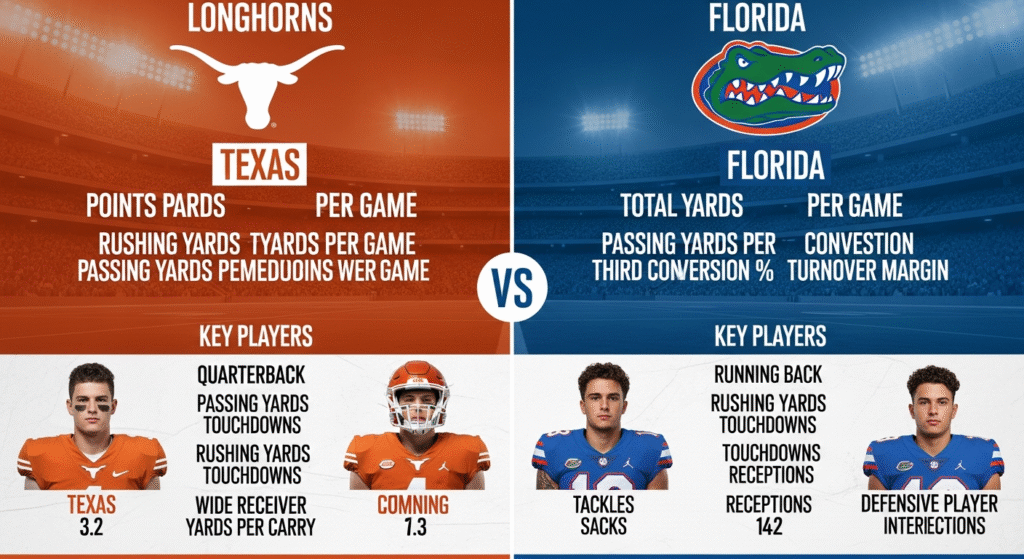
The receiving group for Texas was productive and disciplined. The top wide receiver led the team in receptions and receiving yards, consistently creating separation and converting key third downs. Another receiver contributed with a touchdown catch, showcasing strong hands in the red zone.
The tight ends were also involved, particularly in play-action situations. Their blocking helped the run game, while their receptions added reliability in short-yardage passing scenarios.
Florida Gators Offensive Player Stats
The Florida Gators offense relied on athleticism and big-play potential. While there were moments of inconsistency, several players stood out statistically and made a strong impact.
Florida Gators Quarterback Performance
The Florida quarterback showcased his dual-threat capability throughout the match. He threw for a respectable number of passing yards and connected on multiple deep throws that energized the offense. Although he faced pressure from Texas defenders, his mobility allowed him to escape sacks and extend plays.
On the ground, the quarterback added valuable rushing yards, particularly on designed quarterback runs and scrambles. His total offensive contribution was one of the highlights for Florida.
Florida Gators Running Backs Stats
Florida’s running backs displayed speed and explosiveness. The primary running back recorded strong rushing numbers, including several runs that gained significant yardage. His ability to break tackles was evident in his yards after contact.
Another running back contributed as a change-of-pace option, adding both rushing and receiving yards. Together, the Florida running backs kept the Texas defense on alert throughout the game.
Florida Gators Wide Receivers and Tight Ends
The Gators’ wide receivers were instrumental in creating big plays. The leading receiver finished with high receiving yards and a touchdown, demonstrating excellent route-running and body control. Another receiver made critical catches in clutch situations, helping Florida sustain offensive momentum.
The tight ends also played a supporting role, especially in short-yardage situations and red-zone plays, contributing valuable receptions and blocking support.
Texas Longhorns Defensive Player Stats
Texas’ defense played a disciplined and aggressive game, focusing on limiting explosive plays and forcing Florida into difficult third-down situations.
Texas Longhorns Defensive Line Performance
The defensive line was a major factor in the game. Texas linemen recorded multiple tackles for loss and applied consistent pressure on the Florida quarterback. Their ability to collapse the pocket disrupted Florida’s timing and reduced the effectiveness of deep passing plays.
Texas Longhorns Linebackers Stats
Texas linebackers were active across the field. The leading linebacker topped the team in total tackles, showing excellent instincts and pursuit speed. He also recorded a sack and a tackle for loss, highlighting his versatility.
Other linebackers contributed in coverage, limiting Florida’s short passing game and preventing running backs from gaining easy yards after the catch.
Texas Longhorns Secondary Performance
The secondary delivered a solid performance, recording pass breakups and limiting Florida’s receivers in critical moments. A key interception shifted momentum in favor of Texas and prevented a potential scoring drive.
Defensive backs also played a role in run support, making open-field tackles and preventing long gains.
Florida Gators Defensive Player Stats
Florida’s defense showed resilience and physicality, particularly in the second half, as they adjusted to Texas’ offensive approach.
Florida Gators Defensive Line Performance
The defensive line for Florida applied pressure and recorded sacks at crucial moments. Their ability to disrupt the Texas quarterback forced hurried throws and occasional negative plays.
They also contributed to stopping the run, limiting Texas to modest gains on early downs during certain stretches of the game.
Florida Gators Linebackers Stats
Florida linebackers were heavily involved in stopping Texas’ rushing attack. The team’s leading tackler recorded a high number of solo and assisted tackles, consistently meeting ball carriers near the line of scrimmage.
Linebackers also contributed in pass coverage, breaking up passes and preventing Texas from exploiting the middle of the field.
Florida Gators Secondary Performance
The Florida secondary faced a challenging task against Texas’ balanced passing attack. While they allowed several completions, they also made key plays, including pass deflections and tight coverage in the red zone.
A forced turnover by the defensive backs gave Florida a chance to swing momentum, highlighting their playmaking ability.
Special Teams Player Stats and Impact
Special teams played a subtle but important role in the Texas Longhorns vs Florida Gators football match.
Texas’ kicker was reliable, converting field goal attempts and extra points, which proved valuable in a closely contested game. The punter consistently flipped field position, pinning Florida deep on multiple occasions.
Florida’s return specialists provided energy with solid kickoff and punt returns, setting up favorable field position. Their kicker also delivered consistent performances, keeping Florida within striking distance throughout the match.
Key Statistical Comparisons
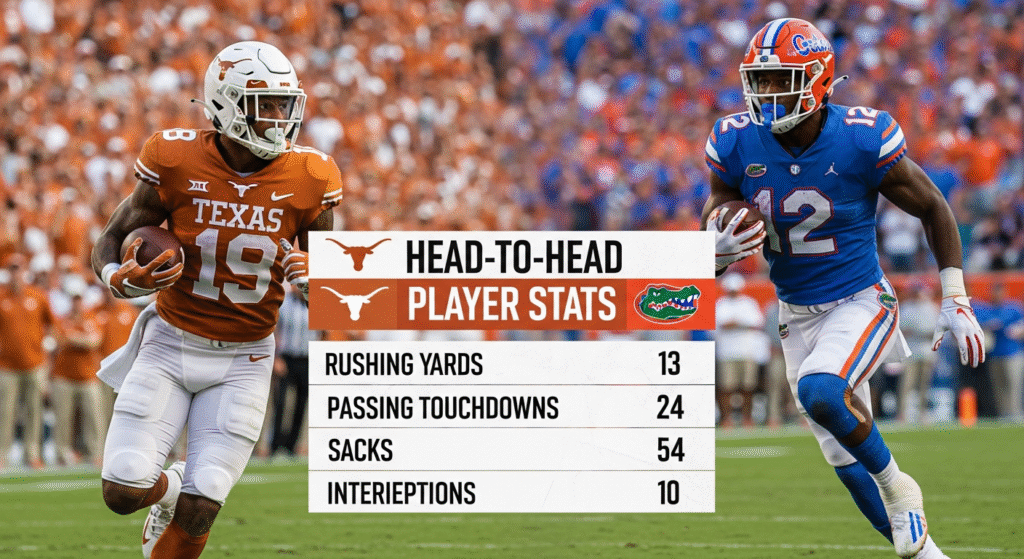
When comparing team statistics, Texas held an edge in time of possession and third-down efficiency, reflecting their methodical offensive approach. Florida, on the other hand, excelled in explosive plays and total yards per play.
Turnovers played a significant role, with Texas capitalizing on Florida mistakes and converting them into points. Penalty discipline also favored Texas, as fewer penalties helped them maintain offensive rhythm.
Overall Player Performance Takeaways
The Texas Longhorns vs Florida Gators football match was defined by strong individual performances on both sides. Texas’ balanced offense and disciplined defense allowed them to control key moments of the game. Florida’s athleticism and explosive players kept the contest competitive and showcased the depth of their roster.
From quarterbacks to defensive standouts, the player stats tell the story of a hard-fought battle between two elite college football programs.
Conclusion
The Texas Longhorns football vs Florida Gators football match was a showcase of elite college football talent. Detailed player stats reveal how execution, discipline, and timely plays ultimately shaped the game. Both teams displayed strengths that fans can build excitement around for the rest of the season, making this matchup a memorable chapter in college football history.
FAQs
Who was the standout player in the Texas Longhorns vs Florida Gators football match?
Several players stood out, but Texas’ quarterback and leading linebacker played especially impactful roles, while Florida’s quarterback and top wide receiver also delivered strong performances.
How did Texas Longhorns use player stats to their advantage?
Texas focused on efficiency, limiting turnovers, and controlling possession, which is reflected in their passing accuracy, rushing balance, and defensive tackle numbers.
What were the key differences in Florida Gators player stats?
Florida relied more on explosive plays and quarterback mobility, resulting in higher yards per play but less consistency compared to Texas.
Did defense play a major role in the outcome?
Yes, defensive pressure, turnovers, and third-down stops were crucial factors that influenced the final result.What does this match mean for both teams moving forward?
The match highlighted Texas’ discipline and depth, while Florida demonstrated strong athletic potential. Both teams gained valuable experience that will shape their approach in future games.